
Baker County Most Wanted Status
Baker County's sheriff, Dana Meade, runs an office site with an agency home and navigation hub, press releases, a tip form, and contact details. What it does not have is a most-wanted page. The complete sitemap lists no warrant search, no wanted roster, and no public lineup of names.
So there is no official county list to quote. No names, no photos, no count, no update schedule. Anyone asking who appears on the Baker County most wanted list is really asking about fragments. News stories and social posts can describe one case at a time, but they are not a standing roster. Consider the 2022 WALB report about an armed-robbery investigation, which later confirmed both subjects were already in custody. A wanted caption can go stale fast.
Where should a reader turn? The sheriff's current notice, or the court handling the case. If an agency releases a booking photo for one investigation, it stays with that source. Old news pages and commercial galleries should never be stitched into a face grid of Baker County arrests.
Safety first. A caption or photo is not a reason to confront anyone. Call law enforcement and let trained officers make contact.
What Baker Wanted Notices Show
There is no published list right now. The field breakdown below still works as a reference. It shows what an official notice would typically state. Treat it as a model, not a live record. Fields like a warrant number or charge can change, so check the actual notice before you pass any detail along.
| Possible field | Baker County finding |
|---|---|
| Name or alias | No official Baker list publishes a current name field. |
| Photo | No public sheriff wanted-page photo display was located. |
| Warrant basis or allegation | No listing field or live warrant description is published by the sheriff's site. |
| Physical description | Not documented in a Baker County list. |
| Last known area | Not documented. Do not infer location from an old story. |
| Update or custody status | No cadence or current-status field is promised. |
| Tip instructions | The sheriff has a general crime-tip form, but it does not by itself promise anonymity or a reward. |
A court warrant is not the same thing as a curated most-wanted notice. Many warrants may never be placed on a public list, and an old notice may not reflect a recall, surrender, arrest, or other change. Treat “not on a list” and “no warrant” as different statements.
How to Read Baker Wanted Notices
A wanted notice is a request for information. Nothing more. Treat it that way. Two details deserve a close look: the date on the notice and the agency that issued it. News outlets often quote these bulletins, but the agency's own posting controls whether a case is still open. Let that source have the final word on status.
- Confirm the jurisdiction. Check that the notice identifies Baker County, Georgia, the Baker County Sheriff's Office, or the named local police agency.
- Read the date, case description, and update language. Do not rely on a repost that has no date or that points to another Baker County in another state.
- Compare the identity details carefully. A name match alone is not enough, and a photograph should not be copied or redistributed.
- Send information through the current official tip route. Do not confront, follow, threaten, or announce a person's location publicly.
- For a later booking or court result, use the county record path and court sources described in the Baker County booking and mugshot lookup.
Older press releases from the sheriff can be useful background. They are not a live wanted list. A post may get pulled, revised, or replaced by something newer, and there is no way to tell from the outside. Note the date on any item you find. Then confirm with the agency directly before assuming a case remains active.
Baker County Tip Route
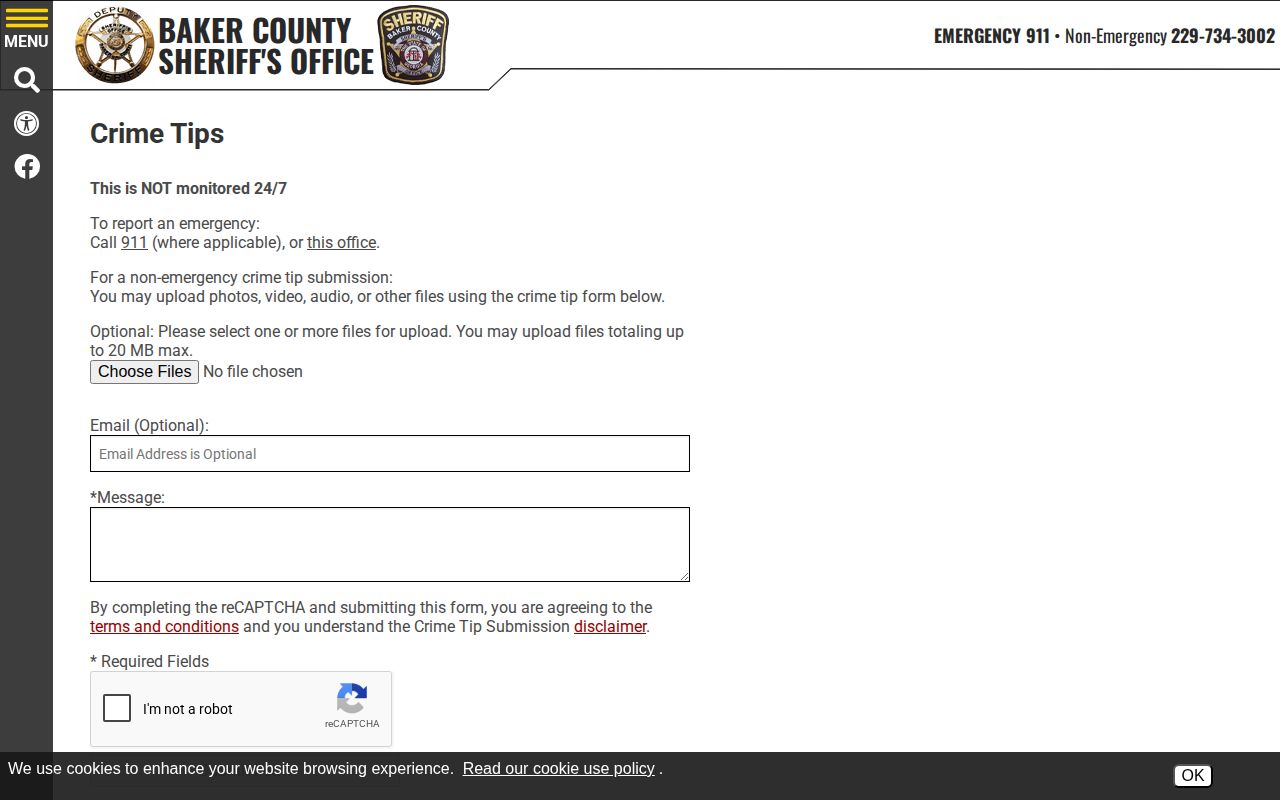
The verified way to report information is the official Baker County Sheriff's crime-tip form. There is no dedicated Crime Stoppers outfit for the county, no posted reward figure, and no separate anonymous tip line. So call the form what it is: a sheriff's reporting channel. It carries no promise of payment or confidentiality.
The form is for information that belongs in law-enforcement hands. It is not a warrant check. It will not file anything with a court, and it cannot be used to ask the sheriff about another person's private status. Sensitive details go through the agency's approved channel. If danger is immediate, call 911 instead.
Baker County Sheriff's Office
167 Baker Place, P.O. Box 441
Newton, GA 39870
Non-emergency: (229) 734-3002, 24 hours
Administrative: (229) 734-3003
One caution comes from the sheriff's contact page. Email is not watched around the clock, and the agency advises against sending confidential personal details through unencrypted email. Whatever instructions the agency shows when you make contact are the ones to follow. The official Baker County crime-tip form is the verified reporting route shown here.
Check a Baker County Warrant
Baker County has no online warrant-check portal. The sheriff also lacks a separate warrants-unit phone line. For procedure, start with the main sheriff number, (229) 734-3002. The Baker Clerk of Superior Court can help you locate public court-file material, though the clerk's site is not a live warrant database and should not be described that way.
A warrant is a specific legal process. Confirming one may take the issuing court, the sheriff, or another agency, since a public docket can lag behind or differ from live law-enforcement status. A commercial website's caption is never proof that a warrant is active.
- Gather the person's full name and, when lawful and necessary, a case number or date that can distinguish similar names.
- Call the sheriff for the current procedure and ask which office handles the relevant warrant question.
- Contact the appropriate court or the Baker Clerk of Superior Court for public case documents and docket information.
- If the question concerns the person asking, contact an attorney or the appropriate court for lawful guidance rather than trying to avoid service or arrest.
- For a later booking record, use the sheriff's records route. A warrant check and a booking-photo request are separate requests.
Anyone who might be named on a warrant should take the lawful path. That means a lawyer, contact with the court, and compliance with whatever instructions the proper authority gives. Do not send a friend to approach officers. Do not invent a false identity. Every evasion step only makes the situation worse.
Warrant Terms to Confirm
Baker's public website posts no official list of warrant categories. The plain-language terms on this page work better as questions. Ask the sheriff or the court which ones apply to a given case. No live Baker roster is known to use these labels. No name should be attached to them without confirmation from the agency itself.
| Term | Question for the proper office |
|---|---|
| Arrest warrant | Was a judge's process issued in a criminal matter, and which agency can confirm its current status? |
| Bench warrant | Did a court issue a process connected to a missed court event or order, and what is the lawful way to address it? |
| Probation or supervision process | Is the question handled by a supervising authority rather than the county jail or clerk? |
| Other hold or detainer | Is another agency asking for notification or custody, and which office owns that record? |
A warrant and a detainer are different things. A detainer is often just a request from another authority regarding someone already in custody. In Baker County, the jail may hold one piece of the record. The court may hold another. An outside agency may hold a third. A complete answer can take more than one phone call.
Baker Warrants and Court Records
The court file tells the story that follows an arrest. After a warrant or booking, a case can move through a first appearance, a bond hearing, an arraignment, a plea, a dismissal, or a sentencing. The sheriff's court-information page lists local court contacts. The clerk can pull the underlying public documents.
A Georgia Department of Corrections record is separate from a wanted notice. GDC tracks people in state custody. Someone lands in that system only after a sentence or another qualifying status. The GDC offender search will not confirm a Baker County warrant or current county custody.
Old posts can mislead. A 2022 Baker County news item was one example. It was later updated to say both subjects were in custody. Before repeating any wanted status, check the current agency source first.
With no Baker most-wanted page to browse, the public cannot count wanted people here or scroll a current photo list. The real value is routing. Current tips belong with the sheriff. Warrant procedure belongs with the sheriff and the court, and booking questions go back to whichever office holds the record.
Baker Social Status Changes
The sheriff's official Facebook link and press archive sometimes carry safety updates. No evidence points to a regular booking-post schedule. Nor is there a "Warrant Wednesday" feature. A social post can give you a time-stamped lead, but it never adds up to a full warrant record.
WALB's reporting shows why a custody update beats an old headline. Someone described as wanted in one story may already be in custody when the next reader finds it. Skip the stale photo or caption. Share the current official tip route instead.
Never approach anyone because of a social post. Urgent tips go to 911. Less urgent ones go through the sheriff's current contact or tip form. Checking on your own status? Talk to a lawyer or the court.